Chapter 26
 Art's bank has $100,000 of deposits and $100,000 of
reserves. Suppose that the required reserve ratio is 25%. In
other words, Art's bank must keep 25% of its deposits on hand as
reserves. Thus, of the $100,000 of new deposits, Art's bank must
keep only $25,000 as reserves. However, it initially has $100,000
of reserves, so that it has $75,000 of excess reserves, reserves
over and above what it must legally maintain.
Art's bank has $100,000 of deposits and $100,000 of
reserves. Suppose that the required reserve ratio is 25%. In
other words, Art's bank must keep 25% of its deposits on hand as
reserves. Thus, of the $100,000 of new deposits, Art's bank must
keep only $25,000 as reserves. However, it initially has $100,000
of reserves, so that it has $75,000 of excess reserves, reserves
over and above what it must legally maintain.
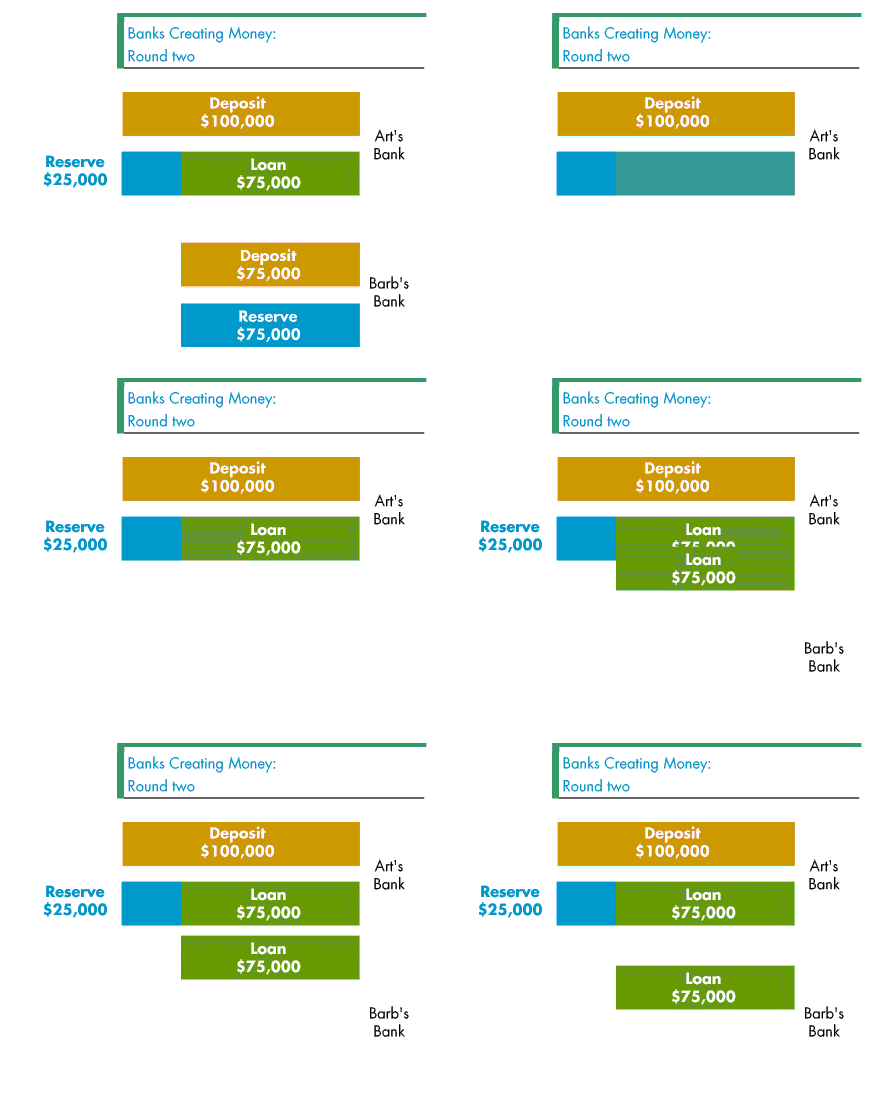
The excess reserves do not especially thrill Art's bank because these extra reserves earn it no interest income. Hence, Art's bank looks to loan out these excess reserves in order to gain interest income on the loan. Along comes Amy who needs a $75,000 loan to buy a copy shop. Art's bank loans the $75,000 to Amy. Amy uses the loan to write a check to Barb in order to buy a copy shop from Barb. Barb then takes the $75,000 check to her bank and deposits it.
We see these changes in the figure. Art's bank loans Amy the $75,000 and thereby "converts" the $75,000 in excess reserves into a $75,000 loan. Amy uses the loan to write a check to Barb. Barb rushes to her bank to deposit her check. When Barb deposits her check, her bank now has $75,000 in deposits and $75,000 in reserves.
The story does not end at Barb's bank, however. There are still more chapters to be completed. Click on the figure below to go to the next phase.
 |