Chapter 26
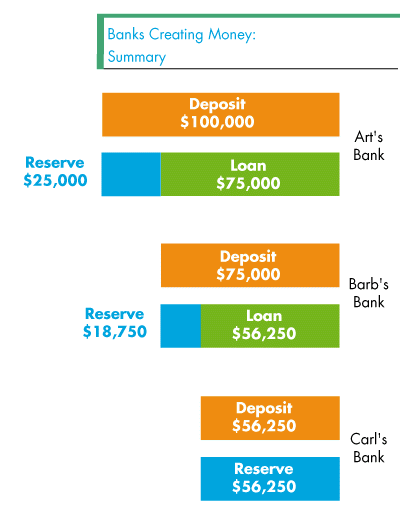
We know that Carl's bank desires to keep only 25 percent of Carl's $56,250 deposit or $14,063 as reserves. We also know that Carl's bank has $42,187 in excess reserves that it wishes to loan. So we could continue the lending and relending and re-relending story some more, but instead let's stop and see the net effect on the money supply at this point.
We see in the figure that Art's bank has an extra $100,000 in deposits; Barb's bank has an extra $75,000; and Carl's bank has an extra $56,250. Thus at this point in the process, we can calculate that these three banks have a total of $231,250 of deposits. In other words, Art's initial $100,000 of currency has been "multiplied" into a little more than $231,000 of deposits. The $231,000 of deposits are money to Art, Barb, and Carl. So, the money supply has increased beyond the initial $100,000 of currency, that is, beyond the initial $100,000 of reserves.
The result that the quantity of deposits made has increased beyond the initial $100,000 of reserves means that ! The process by which the banks created the additional money is by making loans. When a bank receives extra reserves beyond those it desires to keep, the bank loans the excess. This loan then ends up as a deposit (money!) in another bank, which then gives the other bank extra reserves. This bank, in turn, loans its excess reserves and the process continues.

Understanding how banks create money is fundamental to understanding how the Reserve Bank of Australia controls the nation's money supply, a topic taken up in the next chapter. And, understanding the Reserve Bank of Australia 's control over the money supply is necessary to understand theories of business cycles and some of the suggested policy responses to business cycles, topics also taken up in future chapters. Hence it is worthwhile to have a good grasp of the method by which banks create money. The Study Guide to accompany the textbook can help you in this endeavour. Read Learning Challengers and then answer True or False questions 11 to 13, Multiple Choice questions 12, 13, and 14; Problem 1. Be sure not to miss any of these questions to be confident that you thoroughly understand how banks create money.
Would you like to study another chapter?