Chapter 11
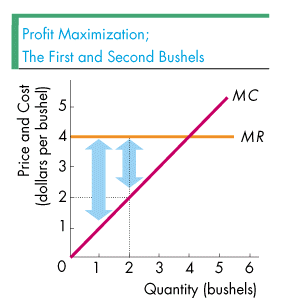
 After yelling
"STOP!" you might reasonably ask "Why would
Jonathan want to produce the second bushel when it yields a
profit of only $2 while his first bushel had a profit of $3?
Why not grow only the first bushel?"
After yelling
"STOP!" you might reasonably ask "Why would
Jonathan want to produce the second bushel when it yields a
profit of only $2 while his first bushel had a profit of $3?
Why not grow only the first bushel?"
The answer to this question lies in calculating Jonathan's total profit after producing 1 bushel and after producing 2 bushels. If Jonathan produces 1 bushel of wheat, his total profit is $3, the large blue arrow. If Jonathan produces 2 bushels, he has a $3 profit on the first bushel and a $2 profit on the second. Thus Jonathan's total profit if he produces 2 bushels is $5 (= $3 + $2), the sum of the large and small blue arrows. Thus Jonathan's total profit if he produces 2 bushels is larger than his total profit if he produces only 1 bushel. Jonathan's goal is to earn the maximum possible total profit, so he will definitely grow the second bushel of wheat.
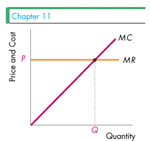
Indeed, this answer shows us that as long as the marginal revenue of a bushel (or fraction of a bushel) is greater than the marginal cost of the bushel (or fraction), producing the output adds to the total profit. Hence Jonathan produces all the units of wheat for which the marginal revenue exceeds the marginal cost. Conversely, Jonathan does not produce any unit of output for which the marginal cost exceeds the marginal revenue because producing these units reduces Jonathan's total profit.
To see what these rules imply for the more general question about much output Jonathan chooses to produce in total, click on the icon below.
 |